Logistics Base Seitz
← Back to the bases map · Roll call · In memoriam: Pfc. Jesse D. Mizener · In memoriam: SPC Stephen M. Cruz · Under fire: the record · Medical support · The 1014th QM Co · 1014th QM photographs · The book Surviving Twilight · Message board
| Also known as | Log Base Seitz; Logistical Base Seitz; LB Seitz; Contingency Operating Location (COL) Seitz (later designation); “Seitzkatraz” and “Impact Zone Seitz” (soldiers' nicknames) |
|---|---|
| Location | West Baghdad, a few hundred yards north of the Baghdad International Airport perimeter, near Abu Ghraib |
| Type | Army logistics base (later contingency operating location) |
| Category | U.S. installation in Iraq |
| Opened | April 2003 |
| Closed or transferred | Not stated in the sources consulted; still in U.S. use as COL Seitz in January 2010 |
| Coordinates | 33.26250, 44.23444 (33°15′45.0″N 44°14′04.0″E) — approximate |
In Memoriam
Private First Class Jesse D. Mizener
542nd Maintenance Company · 44th Corps Support Battalion · 593rd Corps Support Group · Fort Lewis, Washington
December 24, 1980 – January 7, 2004 • Killed in action, Logistics Base Seitz, Iraq • Bronze Star, Purple Heart
On the evening of January 7, 2004, Jesse Mizener called home from Logistics Base Seitz. He told his wife he would message her as soon as he got out of the shower. Minutes later, insurgents fired six mortar rounds into the base. A 60 mm round came through the roof of the 542nd's barracks bay and sprayed fragments across it. A soldier who was about 30 feet away remembered his squad leader putting everything into trying to save him while the others gave first aid, built litters and carried the wounded to the medics. Jesse was killed, and more than thirty of his fellow soldiers were wounded.
He was born in Santa Clara, California, and grew up in Stockton, where he played football at Bear Creek High School. He earned his GED and served with the California Conservation Corps in Auburn, where he volunteered at banquets for veterans and the homeless. Joining the Army in September 2002 fulfilled a childhood dream. After basic training at Fort Leonard Wood, Missouri, he was stationed at Fort Lewis, Washington, as a heavy equipment mechanic. He deployed to Iraq in April 2003 with the logistics soldiers who built Seitz out of a burned-out compound. He hoped to become a highway patrol officer when he came home.
He was a husband and the father of three young children, and he left behind his parents, a brother, a sister, and his grandparents. His mother said she was saddened by his death but very proud that he died doing what he loved. He was laid to rest at Cherokee Memorial Park in Lodi, California.
“He was a very loving man.” — his wife, Los Angeles Times, January 18, 2004
“I will never forget that day on Log Base Seitz and the faces of his fellow Soldiers when we realized we had lost one of our own.” — Col. (Ret.) Curt Higdon, commander of the 541st Corps Support Battalion, 2013
Sources: Los Angeles Times, January 18, 2004; The Sacramento Bee obituary and guest book; a 542nd Maintenance Company veteran's account. If you served with Jesse, you can share a memory in the tribute book below.
Also remembered at Log Base Seitz
- Spc. Joshua L. Knowles, 1133rd Transportation Company, Iowa Army National Guard — February 5, 2004
- Staff Sgt. Ivory L. Phipps, 1544th Transportation Company, Illinois Army National Guard — March 17, 2004
- Spc. Melvin Y. Mora, 245th Maintenance Company, U.S. Army Reserve — June 6, 2004
- Sgt. Shawna Morrison, 1544th Transportation Company, Illinois Army National Guard — September 5, 2004
- Spc. Charles Lamb, 1544th Transportation Company, Illinois Army National Guard — September 5, 2004
Tribute book: Pfc. Jesse D. Mizener
Leave a remembrance for Jesse. Tributes are reviewed before they appear.
In Memoriam
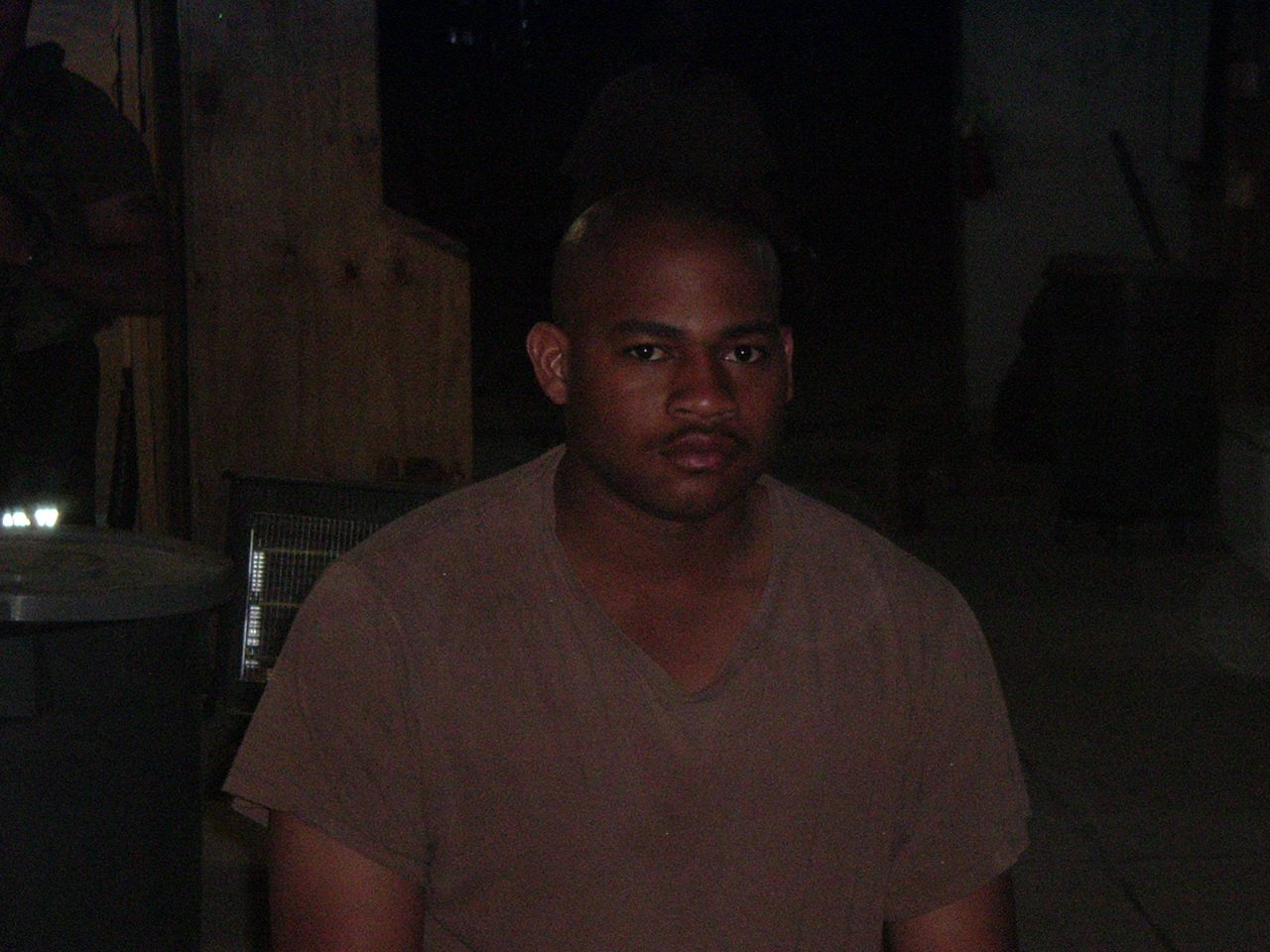
Specialist Stephen Matthew Cruz
U.S. Army · 1014th Quartermaster Company · Operation Iraqi Freedom, 2003–2004
February 5, 1980 – December 15, 2015 • A beloved member of the 1014th
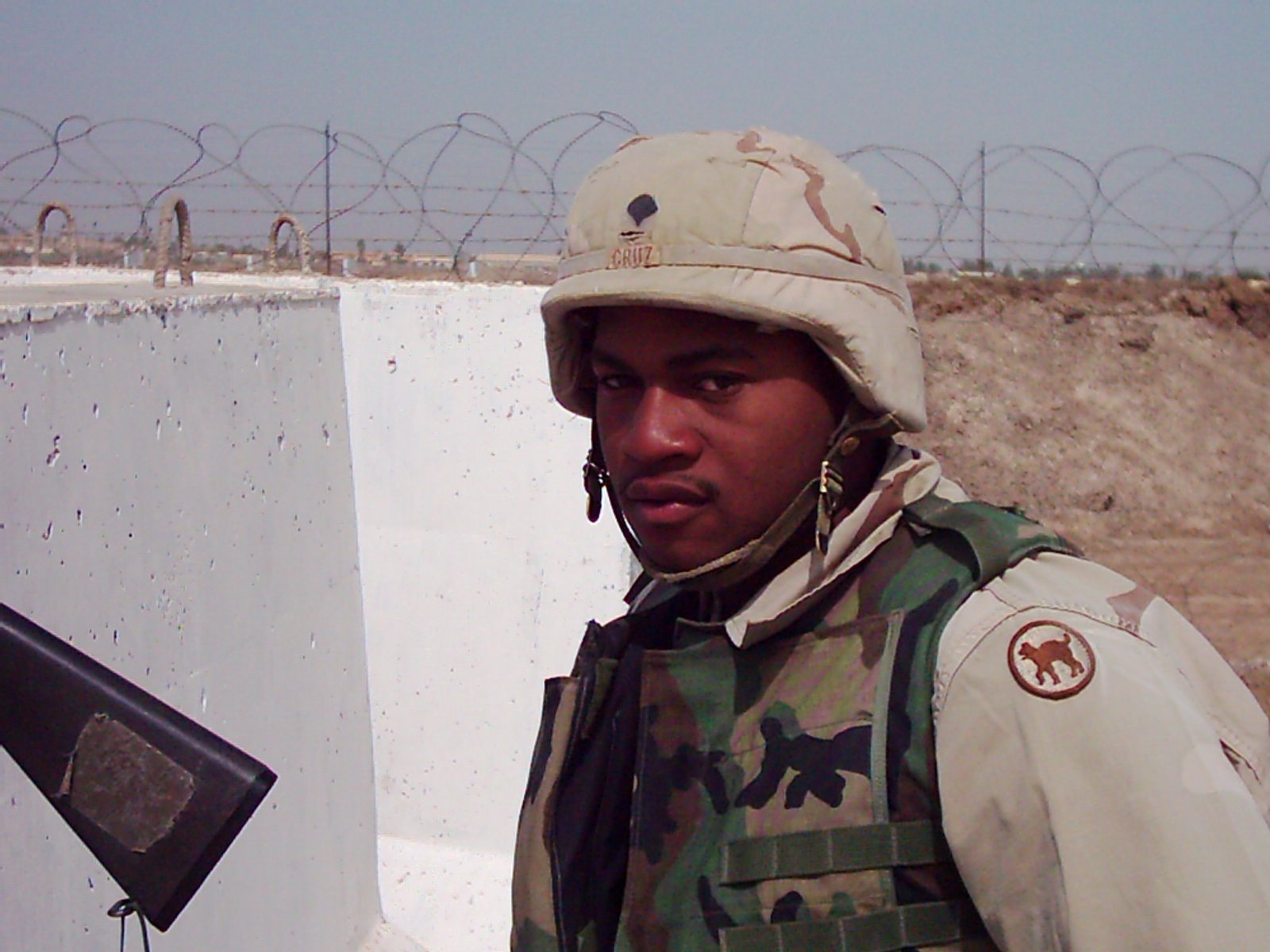
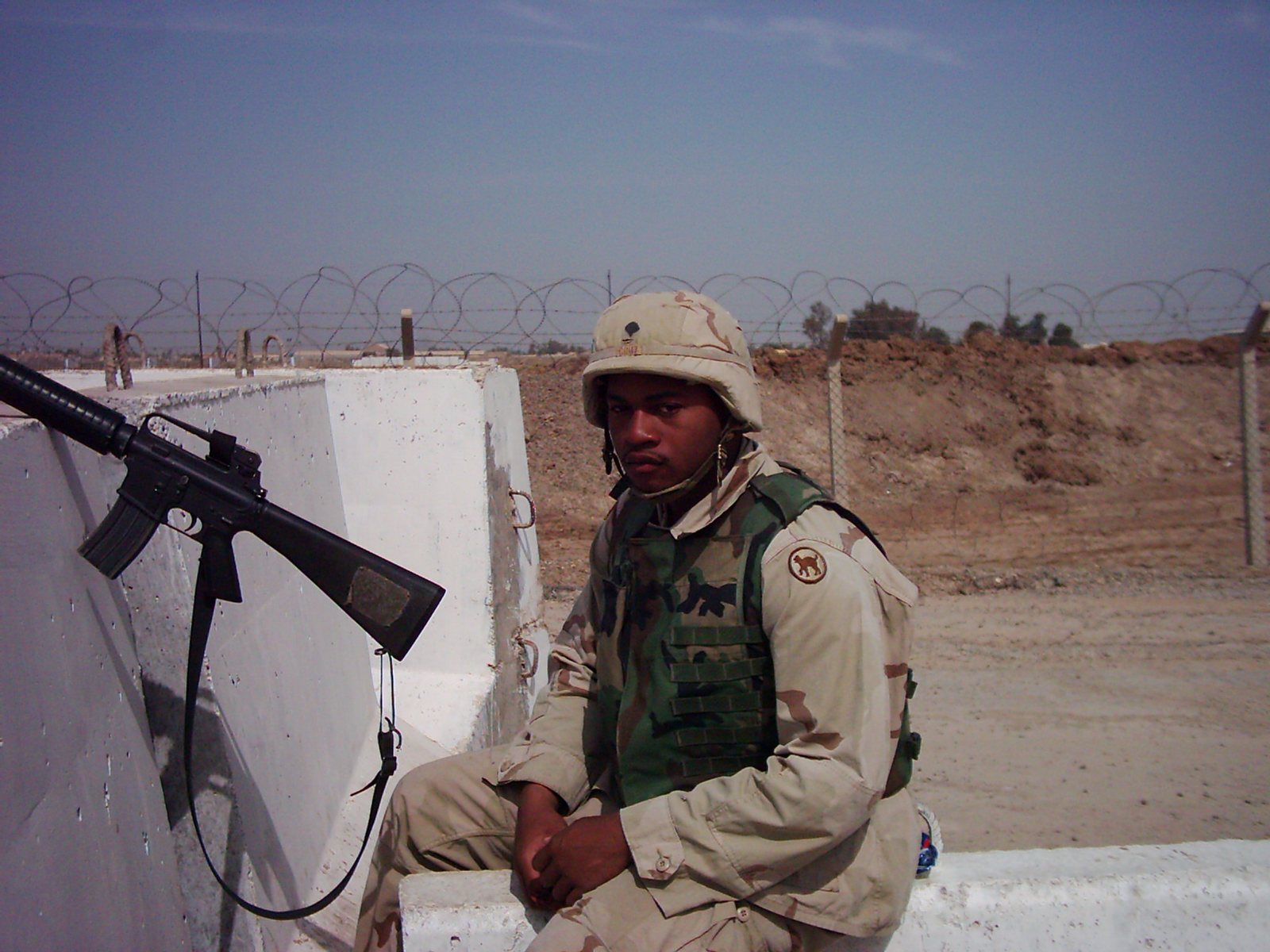
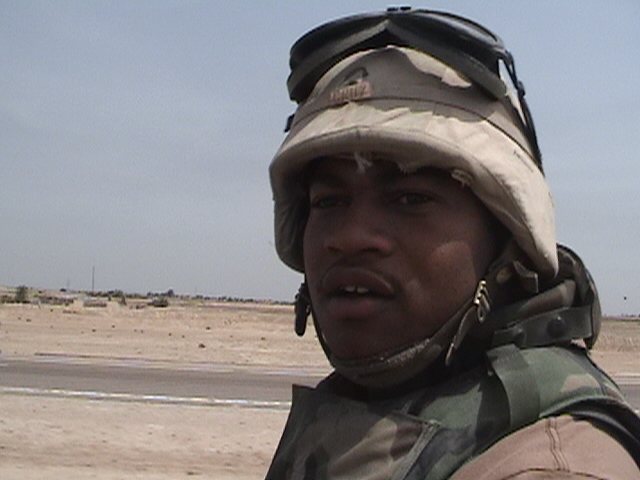
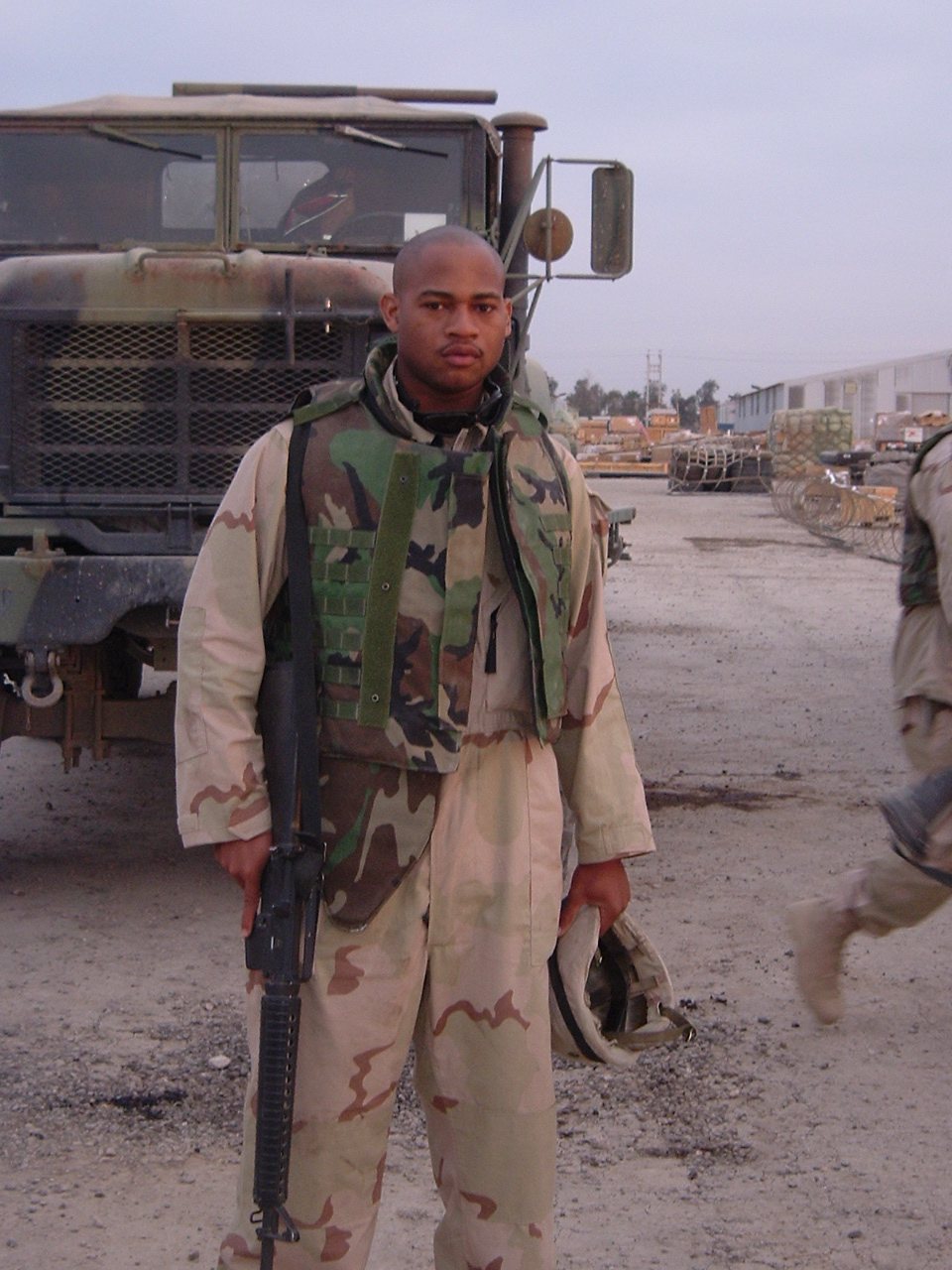
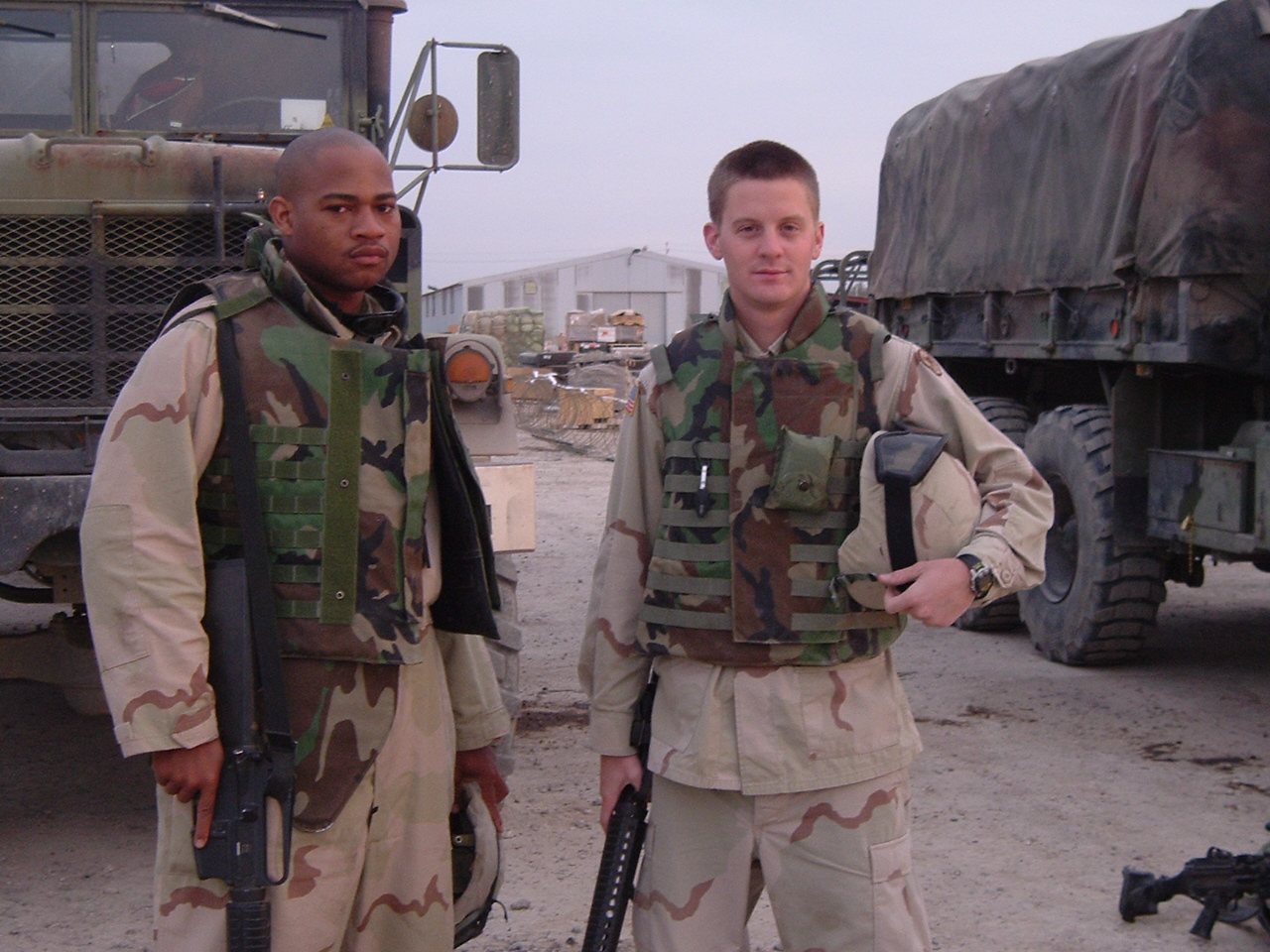
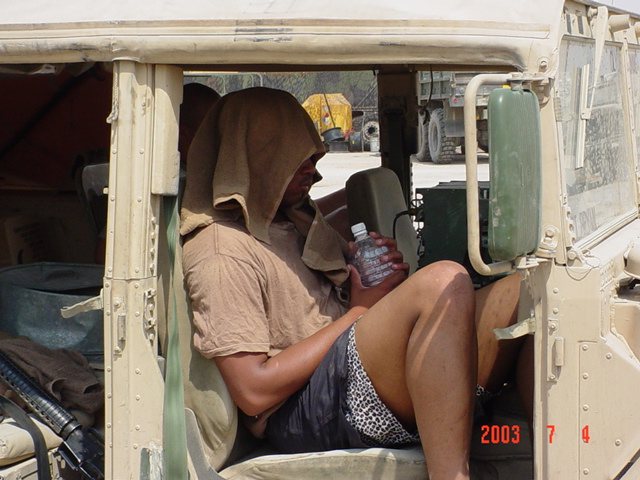
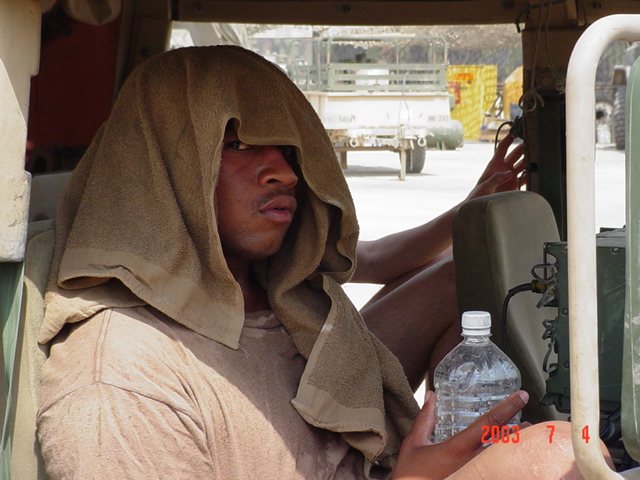
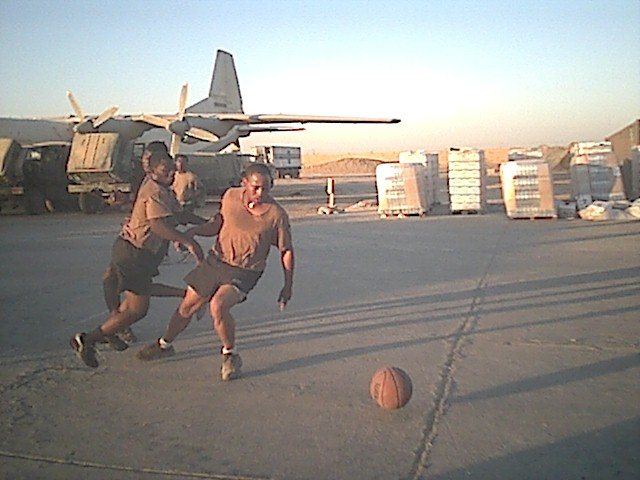
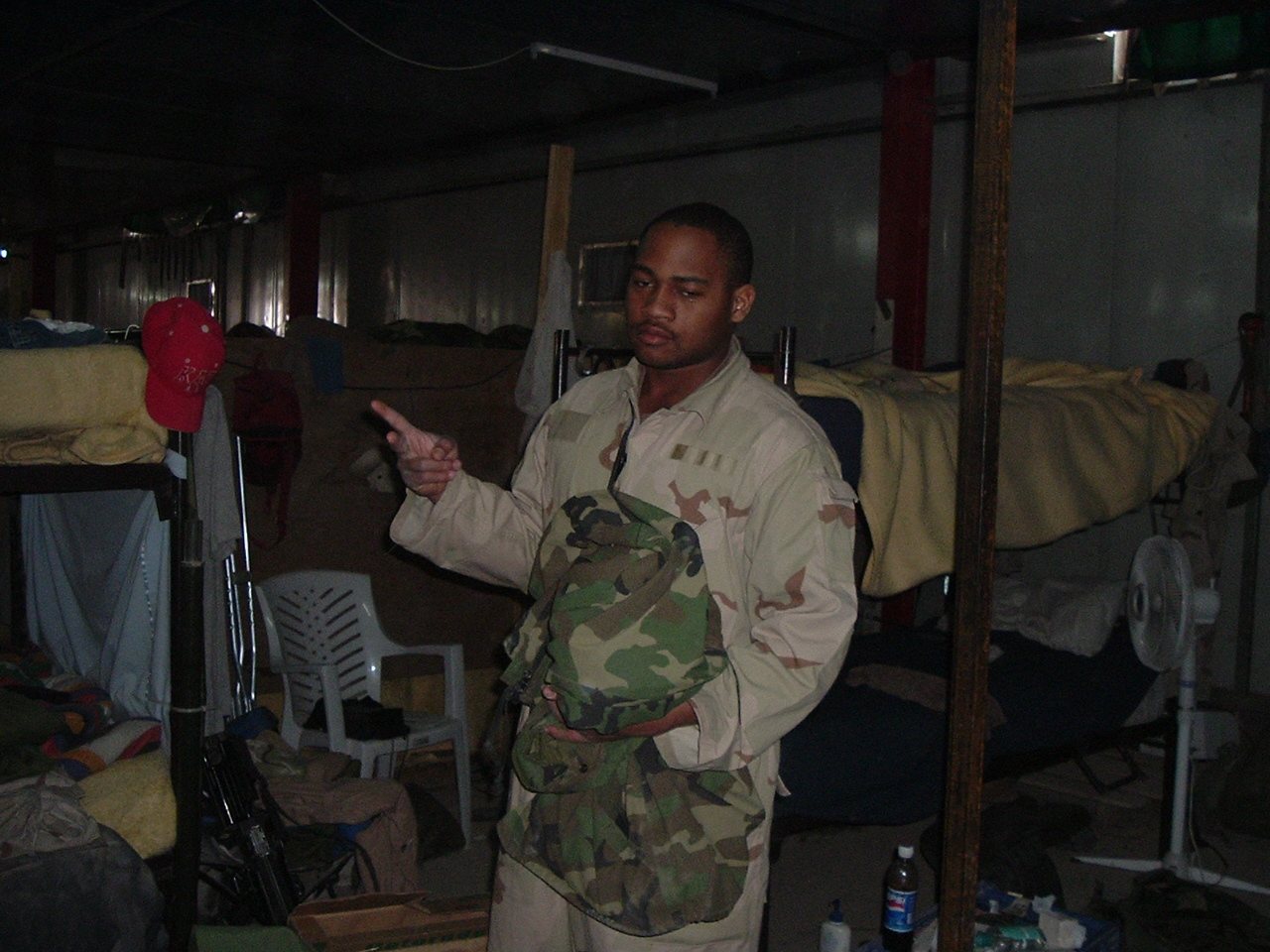
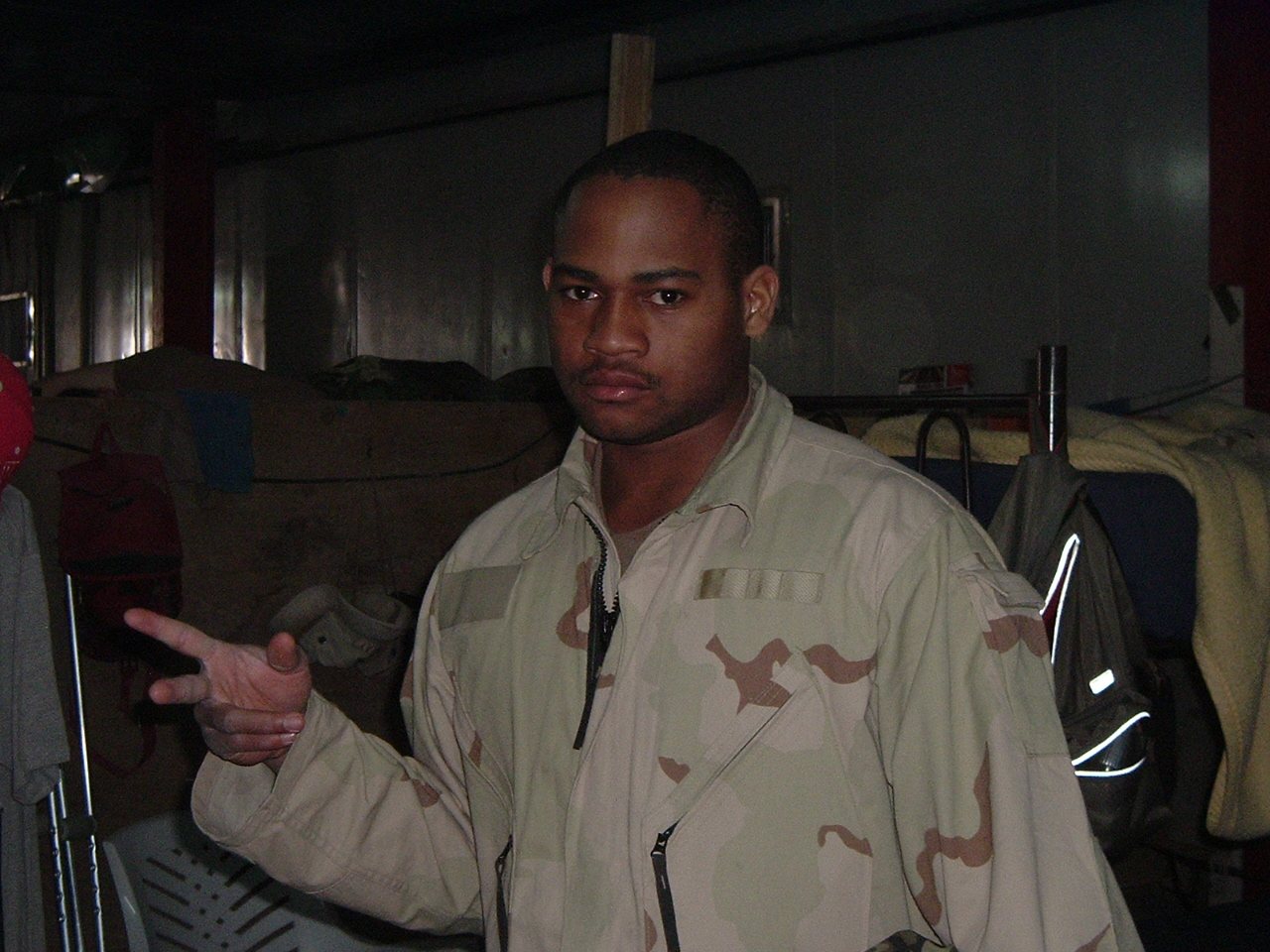
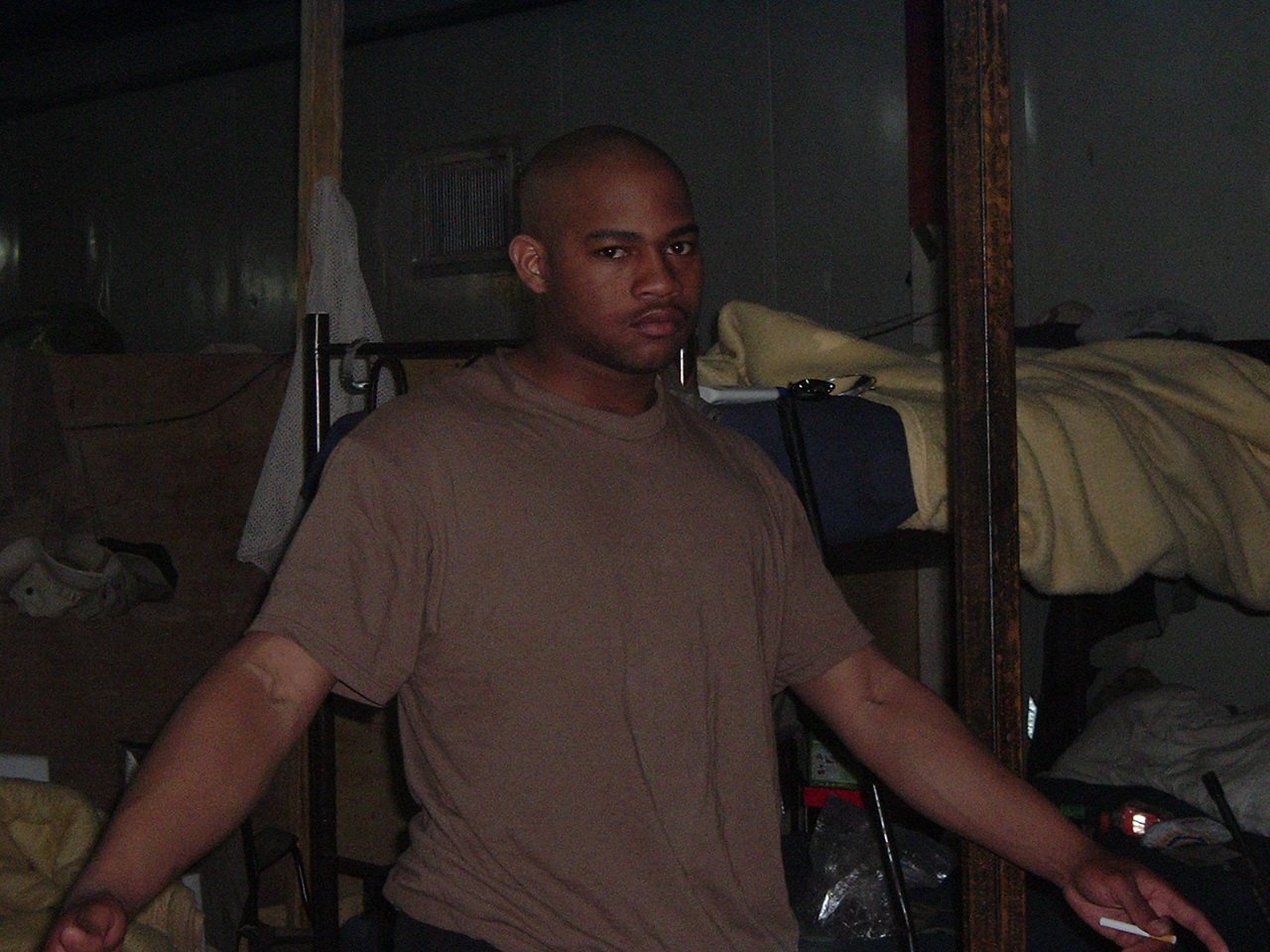
Stephen Cruz deployed to Iraq with the 1014th Quartermaster Company and served with the company at Log Base Seitz in 2003 and 2004. The pictures his fellow soldiers kept show the year as they lived it: guard shifts behind concrete barriers, long runs in the cab of a truck, a wet towel against the summer heat on the Fourth of July, pickup basketball, and quiet hours in the barracks between missions.
He came home. On December 15, 2015, Stephen died by suicide in Georgia. He was 35. He rests at Georgia National Cemetery in Canton, Georgia, in Section 2, Site 2851, under a headstone that reads “SPC US Army, Persian Gulf.” To the soldiers who served beside him, he remains a beloved member of the 1014th, and he is missed.
He is one of the veterans the phrase “22 a day” was meant to remember: the service members and veterans lost to suicide after the war, long after the last convoy came home. The number comes from a 2012 Department of Veterans Affairs report; more recent VA reports put the figure at about 17 veterans a day. Every one of them had a name. This is his.
Dates and burial: Find a Grave memorial 175299476, Georgia National Cemetery. If you served with Stephen, please share a memory in his tribute book below.
Remembering Stephen

Tribute book: Specialist Stephen Matthew Cruz
Leave a remembrance for Stephen. Tributes are reviewed before they appear.
Overview
Logistics Base Seitz was a U.S. Army logistics hub on the western edge of Baghdad, set up in April 2003 inside a compound that had once housed members of Saddam Hussein's Republican Guard. Stars and Stripes placed it a few hundred yards north of the Baghdad International Airport perimeter, overlooking the town of Abu Ghraib. When the first soldiers arrived, an officer recalled, the place was “full of crap, on fire and full of dead things,” and the garrison rebuilt it themselves.
Its first tenant, the 541st Corps Support Battalion, ran what it called the largest logistics mission of any battalion in Iraq. By October 2003 more than 1,000 soldiers from 11 quartermaster, maintenance, transportation and chemical companies at Seitz were supporting an estimated 18 percent of the coalition force. In five months they issued about 19 million gallons of fuel, produced more than 27 million gallons of water, and handed out nearly 1.5 million MREs and 452,098 cases of bottled water, driving some 750,000 miles. Every vehicle in greater Baghdad that needed fuel, military or coalition contractor, came to Seitz.
The 541st was a composite battalion. Its companies, listed by GlobalSecurity.org, included the 172nd Chemical Company; the 1st and 542nd Maintenance Companies; the 16th, 53rd, 79th, 827th, 1014th and 1555th Quartermaster Companies; and the 24th, 1123rd, 1133rd and 1161st Transportation Companies. That fall a 542nd Maintenance sergeant painted the battalion's story on the wall of the base Internet café: the unloading in Kuwait, the convoy north past camels and palaces, and a map of Iraq bearing the name of every company. The painting took him nearly four weeks of 14-hour days, interrupted only by mortar attacks.
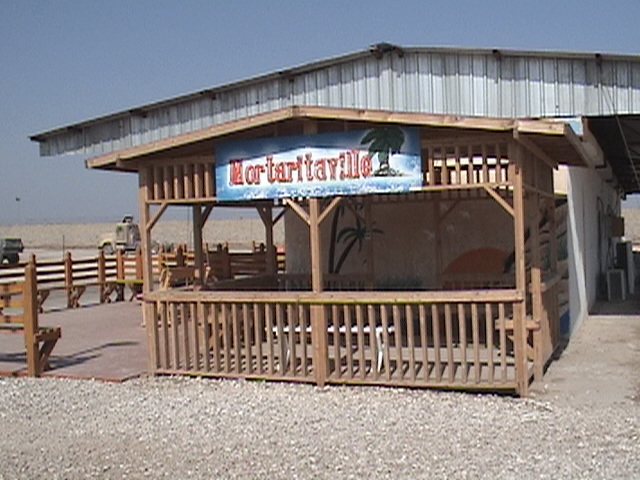
The battalion's leadership in 2003 was Lt. Col. Curt Higdon, the commander; Maj. John Silverstein, the executive officer; and Command Sgt. Maj. Vaneta Vaughn. In October 2003 Silverstein told Stars and Stripes that the battalion had been hit about 25 times, with everything from AK-47 fire to mortars, and had taken 16 wounded in six months. Higdon later wrote that he gave Seitz its nickname, “Mortaritaville,” in October 2003 and asked a soldier to paint the sign. He also wrote: “we'd been given our mission and that was our piece of ground, we defended it well and we accomplished our mission.”
The base was tiny. Sgt. Shane Bernskoetter compared it in October 2004 with the far larger LSA Anaconda: about 0.15 square miles of fenced ground against Anaconda's 15, fewer than 1,000 troops and contractors against 25,000, and at that point 4 deaths and 50 wounded from mortar attacks against Anaconda's 6 and 100. By his arithmetic, Seitz had about 71 times as many mortar deaths per square mile. Veterans say the nickname belonged to Seitz first; it was later used at Anaconda too.
Seitz had no infantry of its own. Base defense was handled in-house by the logistics units, and the soldiers called themselves “Logistics Warriors.” The battalion was roughly half active-duty and half Reserve and National Guard; none of its units had worked together before arriving in April 2003.
The base lay in one of the most hostile districts around Baghdad, and it was mortared relentlessly. Within six months the 541st had been hit about 25 times with everything from AK-47 fire to mortars, with 16 wounded. On the evening of January 7, 2004, six mortar rounds struck the living area, killing Pfc. Jesse D. Mizener and wounding about 35 soldiers, one of the worst single attacks on U.S. troops in Iraq at that time. Attacks went on through 2004: Spc. Joshua L. Knowles was killed on February 5, Staff Sgt. Ivory L. Phipps on March 17, Spc. Melvin Y. Mora on June 6, and Sgt. Shawna Morrison and Spc. Charles Lamb on September 5. A June 30, 2004 attack wounded 11 soldiers. Veterans of the base remember roughly 330 mortar impacts in 2003. A 541st Corps Support Battalion soldier who served there from April 2003 to April 2004 put the count at approximately 310 confirmed hits on the base in his 340 days, which he called a rough estimate. A 245th Maintenance Company soldier counted more than 120 attacks in 2004, and another veteran of the 2004 rotation wrote of well over 100 separate attacks, with about 700 rounds striking within the base. Soldiers nicknamed the base “Seitzkatraz” and “Impact Zone Seitz,” and a “Welcome to Mortaritaville” sign hung there in late 2003.
In March 2004 the New Mexico Army National Guard's 515th Corps Support Battalion took command. It had more than 1,700 soldiers and supported about 25,000 troops in the Baghdad area with water, food, fuel, repair parts, maintenance and transportation. Later rotations included the 4th Sustainment Brigade's units in 2005–2006, when the 590th Field Service Company ran laundry, shower and clothing repair for camps across central Iraq and helped guard the base. By January 2010, Army records refer to the installation as Contingency Operating Location Seitz, and convoys from Joint Base Balad were still running to it.
The base was named for Dick Seitz, a World War II veteran of the 517th Parachute Regimental Combat Team, according to his family. No coordinates for the base have been published; on this site's map it is plotted at Baghdad International Airport and marked approximate.
Under fire: the record
No official tally of the attacks on Seitz has been published. These are the figures from those who commanded, served and wrote there, with their sources. They are counts and estimates from different people and periods, so they should not be added together.
| Who | Period | What they reported | Source |
|---|---|---|---|
| Maj. John Silverstein, executive officer, 541st Corps Support Battalion | April – early October 2003 | “We've been hit probably 25 different times with anything from AK-47s to mortars,” with 16 wounded in six months | Stars and Stripes, October 6, 2003 |
| Lt. Col. Curt Higdon, commander, 541st Corps Support Battalion | October 2003 | Named the base “Mortaritaville” and had the sign painted; later reported the last mortar fell in November 2007 | His comment on A Way with Words, about 2008 |
| Veterans of the base | 2003 | Roughly 330 mortar impacts | Veterans' accounts |
| 541st Corps Support Battalion soldier | April 2003 – April 2004 (340 days) | “Approximately 310 confirmed hits on the base,” a rough estimate | A Way with Words comment |
| Sgt. Shane Bernskoetter, 245th Maintenance Company | As of October 18, 2004 | 4 killed and 50 wounded by mortar attacks on a base of 0.15 square miles with fewer than 1,000 people | Surviving Twilight, p. 266 |
| 245th Maintenance Company soldier | 2004 | “Mortared over 120 times” | A Way with Words comment |
| Veteran of the 2004 rotation | His 2004 tour | “Well over 100 separate mortar attacks,” with about 700 rounds striking within the base | Troy A. Luster, “Freedom is Like a Crown (Part IX): Homecoming” |
| 15th Transportation Company soldier | 2005 | Mortared “nearly daily,” with occasional rockets and frequent small-arms fire; no casualties in his unit | A Way with Words comment |
Medical support at Seitz
Seitz took casualties from its first months, and the people who cared for them deserve a place in its record. The public record of who they were is thin.
| Period | What is known | Source |
|---|---|---|
| 2003 – early 2004 | The unit that ran the base’s aid station in its first year has not been identified in any published source. Soldiers gave each other first aid under fire, built litters and carried the wounded to the medics. After the January 7, 2004 attack, the Army reported that “the wounded soldiers were given first aid and have been evacuated from the site for further medical treatment.” | U.S. military statement, January 7, 2004; veterans’ accounts |
| January 7, 2004 | The wounded from the attack that killed Pfc. Jesse D. Mizener are reported to have been taken to the 28th Combat Support Hospital in Baghdad. This has not been confirmed in an official source. | Memorial post by a veterans’ group |
| March 17, 2004 | A mortar attack killed one soldier and wounded seven. Four of the wounded were treated and returned to duty; three were evacuated to the 31st Combat Support Hospital. | Coalition Press Information Center, via CNN, March 18, 2004 |
| 2005 | The 546th Area Support Medical Company from Fort Hood, Texas, “were the medics for the base for that year,” according to one of its soldiers. A combat medic who arrived on December 24, 2004 remembered treating American soldiers and detained insurgents in the same room, and Iraqi civilians caught up in raids, while mortars fell almost daily. | A Way with Words comment; HAS HEART veteran profile |
Timeline
| When | What happened |
|---|---|
| Apr 2003 | 541st Corps Support Battalion occupies a former Republican Guard compound north of Baghdad International Airport and builds Logistics Base Seitz. |
| Spring 2003 | The 1014th Quartermaster Company convoys north from Camp Arifjan, Kuwait, to the base, a trip of about three days (veteran's account). |
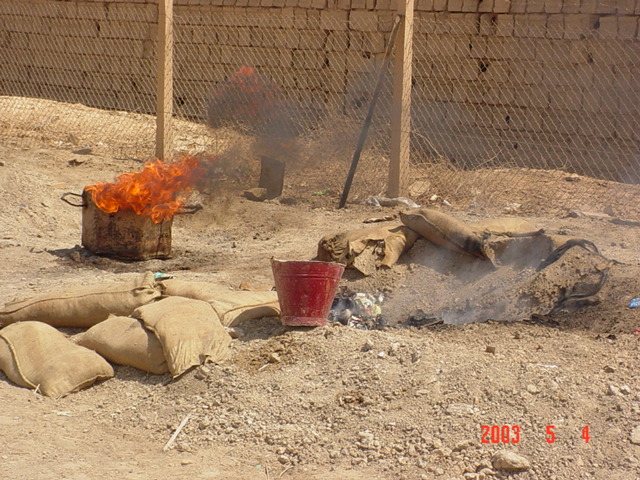
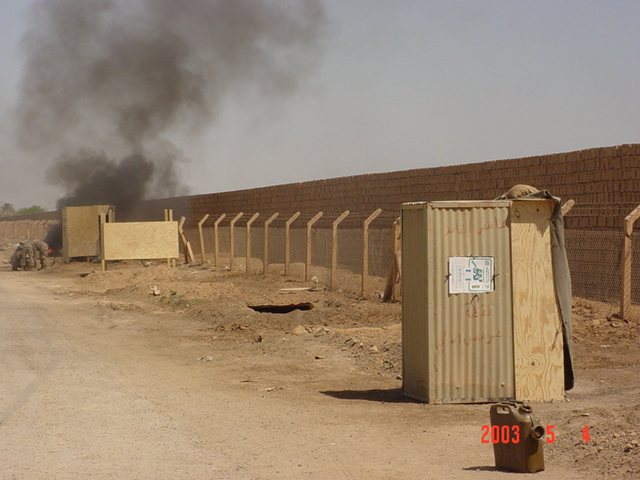
| May 2003 | Photographs taken by the 1014th Quartermaster Company show the company already at work on the base by May 4, building latrines, burning waste and running fuel operations by May 18. |
| Oct 2003 | Stars and Stripes reports more than 1,000 soldiers from 11 companies at Seitz supporting about 18 percent of the coalition force; about 25 attacks and 16 wounded in six months. |
| Oct 2003 | Lt. Col. Curt Higdon, the 541st's commander, names the base “Mortaritaville” and has a soldier paint a sign, which was set up in front of the PX (his account and a veteran's). |
| Sep 9 – Oct 2, 2003 | Sgt. Rene Valdivia of the 542nd Maintenance Company paints a watercolor mural of the 541st CSB's history, from Kuwait to Seitz, on the wall of the base's Internet café and phone center, stopping only for mortar attacks. |
| Oct 2003 | Iowa Army National Guard's 1133rd Transportation Company moves to Seitz from Kuwait. |
| Late 2003 | A “Welcome to Mortaritaville” sign goes up at the base, according to a veteran's account. |
| Dec 2003 | The Illinois Army National Guard's 1544th Transportation Company deploys and is based at Seitz. |
| Nov 21, 2003 | Early-morning attack with 60 mm white phosphorus rounds; fuel bladders on transportation trailers explode (veteran's account). |
| Jan 7, 2004 | Six mortar rounds hit the living area; a 60 mm round crashes through the roof of a 542nd Maintenance Company barracks bay. Pfc. Jesse D. Mizener is killed and about 35 soldiers are wounded, 11 of them from the 1133rd Transportation Company's bay. |
| Feb 5, 2004 | A mortar round hits a 1133rd Transportation Company truck returning from a mission; one soldier killed and one seriously wounded. |
| Mar 17, 2004 | Staff Sgt. Ivory L. Phipps of the 1544th Transportation Company is killed in a mortar attack two days after arriving. |
| Mar 22, 2004 | The 515th Corps Support Battalion (New Mexico ARNG) relieves the 541st CSB. |
| Late Mar 2004 | The 1014th Quartermaster Company's last dated photographs at Seitz, March 28, 2004. |
| Jun 6, 2004 | Spc. Melvin Y. Mora of the 245th Maintenance Company is killed in a mortar attack on the base. |
| Jun 30, 2004 | A mortar attack wounds 11 soldiers. |
| Sep 5, 2004 | Sgt. Shawna Morrison and Spc. Charles Lamb of the 1544th Transportation Company are killed by mortar fire walking back from the dining facility. The National Guard's report described a series of mortar rounds striking the base at about 6 p.m. |
| Dec 2005 | Col. Gustave Perna, commander of the 4th Sustainment Brigade, presents Combat Action Badges to 590th Field Service Company soldiers at Seitz. |
| Jan 2010 | Convoys run from Joint Base Balad to “Contingency Operating Location Seitz.” |
| Nov 2007 | The base takes its last mortar round, according to Col. (Ret.) Curt Higdon, who walked across Seitz again in 2008 and found soldiers still living in the original warehouses, now under large steel shelters. |
Units stationed at Logistics Base Seitz
Units documented in public sources as based at or operating from Logistics Base Seitz. This list is not complete; units rotated frequently and many smaller elements were never reported. Veterans can add their unit on the message board below.
| # | Unit | When | Role at the base | Source |
|---|---|---|---|---|
| 1 | 541st Corps Support Battalion (“Pacesetters”, HHC 541st Maintenance Battalion) | April 2003 – March 2004 | Base command and the logistics mission for greater Baghdad. Commander Lt. Col. Curt Higdon; executive officer Maj. John Silverstein; Command Sgt. Maj. Vaneta Vaughn | link link link |
| 2 | 542nd Maintenance Company | April 2003 – 2004 | Maintenance; Pfc. Jesse D. Mizener's company; Sgt. Rene Valdivia of the company painted the battalion's mural history on the Internet café wall, September–October 2003; commanded during OIF I by Capt. Jesse Wightman; lost Pfc. Jesse D. Mizener, a heavy equipment mechanic, on January 7, 2004 | link link link |
| 3 | 44th Corps Support Battalion (Fort Lewis), 593rd Corps Support Group | 2003–2004 | Parent battalion of the 542nd Maintenance Company | link |
| 4 | 79th Quartermaster Company (U.S. Army Reserve) | 2003 | Quartermaster; worked in the 541st CSB operations center | link |
| 5 | 503rd Military Police Battalion | 2003 | Military police support at Seitz (per a veteran of the base). Stars and Stripes reported in October 2003 that an MP company, the closest thing the base had to infantry, had just departed. | Veteran's account link |
| 6 | 1014th Quartermaster Company (Supply) “Sand Cats”, U.S. Army Reserve, Athens, Georgia | 2003–2004 (at Seitz by early May 2003 through at least late March 2004; arrived by a three-day convoy from Camp Arifjan, Kuwait) | Supply company running Class I (rations and water), Class III (fuel and lubricants), Class IV (construction and barrier materials) and Class VII (major end items) operations; one of the 541st CSB's companies. See the 1014th section below. | Veteran's account link link |
| 7 | 16th Quartermaster Company | 2003–2004 | Quartermaster (per a veteran's account) | link |
| 8 | 1133rd Transportation Company (Iowa Army National Guard) | October 2003 – 2004 | Truck transportation; barracks hit January 7, 2004 | link |
| 9 | 172nd Chemical Company | 2003–2004 | Chemical company; listed among the companies of the 541st Corps Support Battalion, which ran the base | link |
| 10 | 1st Maintenance Company | 2003–2004 | Maintenance; listed among the companies of the 541st Corps Support Battalion, which ran the base | link |
| 11 | 53rd Quartermaster Company | 2003–2004 | Petroleum (POL) supply; listed among the companies of the 541st Corps Support Battalion, which ran the base | link |
| 12 | 827th Quartermaster Company | 2003–2004 | Quartermaster general support; listed among the companies of the 541st Corps Support Battalion, which ran the base | link |
| 13 | 1555th Quartermaster Company | 2003–2004 | Water purification detachment; it spent only a few months at Seitz because the base had no water source to treat (veteran's account) | link link |
| 14 | 24th Transportation Company | 2003–2004 | Medium truck transportation; listed among the companies of the 541st Corps Support Battalion, which ran the base | link |
| 15 | 1123rd Transportation Company | 2003–2004 | Truck transportation; listed among the companies of the 541st Corps Support Battalion, which ran the base | link |
| 16 | 1161st Transportation Company | 2003–2004 | Truck transportation; listed among the companies of the 541st Corps Support Battalion, which ran the base | link |
| 17 | 515th Corps Support Battalion (New Mexico Army National Guard) | From March 22, 2004 (12-month tour) | Base command; more than 1,700 soldiers supporting about 25,000 troops | link |
| 18 | 593rd Corps Support Group | 2004 | Higher headquarters of the 515th CSB, based at Taji | link |
| 19 | 1544th Transportation Company (Illinois Army National Guard) | December 2003 – late 2004 | Paris, Illinois-based truck company; escorted mail and supplies on main supply routes. By September 2004 it had lost four soldiers and had 26 wounded; five of its soldiers were killed during the deployment | link link |
| 20 | 245th Maintenance Company (U.S. Army Reserve, St. Louis) | Late 2003 – 2004 (Operation Iraqi Freedom II) | Maintenance, including small-arms repair; Sgt. Shane Bernskoetter of the company later wrote the memoir Surviving Twilight about his year at Seitz | link link |
| 21 | 4th Sustainment Brigade | 2005–2006 | Brigade headquarters over the Seitz battalions | link |
| 22 | 189th Corps Support Battalion (named as the headquarters at Seitz in the DVIDS article; a photo caption from the same month names the 18th CSB) | December 2005 | Battalion headquarters | link |
| 23 | 590th Field Service Company (Fort Drum) | 2005–2006 | Laundry, shower and clothing repair for camps across central Iraq; part of the base guard force | link |
| 24 | 2nd Battalion, 198th Combined Arms, 155th Heavy Brigade Combat Team (Mississippi ARNG) | January 2010 | Convoys from Joint Base Balad to COL Seitz | link |
| 25 | 13th Sustainment Command (Expeditionary) | January 2010 | Higher command of the 155th HBCT convoy mission | link |
| 26 | Company A, 151st Signal Battalion | May 2003 – January 2004 | Signal support; HHC 151st Signal Battalion soldiers were also at the base (veteran's account) | link |
| 27 | 308th Quartermaster Company | March 2004 – February 2005 | Quartermaster (veteran's account) | link |
| 28 | 850th Transportation Company | 2004 | Truck transportation; its soldiers served beside Sgt. Melvin Mora at the front gate (veteran's account) | link |
| 29 | 546th Area Support Medical Company | January – November 2005 | The base's medics for 2005 (veteran's account) | link |
| 30 | 157th Quartermaster Company | 2005 | Force protection for the base (veteran's account) | link |
| 31 | 15th Transportation Company | 2005 | Wrecker and truck missions; no casualties despite near-daily mortar fire (veteran's account) | link |
Notable events and facts
- Soldiers rebuilt the former Republican Guard compound themselves, adding an internet café, phone bank, a 20-foot movie screen, a basketball court and a sand volleyball court.
- In September 2003 a 542nd Maintenance Company sergeant spent nearly four weeks of 14-hour days painting the 541st Corps Support Battalion's history on the wall of the Internet café; it showed the convoy north from Kuwait, the camels and palaces along the way, and a map naming every company in the battalion.
- The 541st CSB's leadership said base defense was handled entirely by its own logistics soldiers, without combat arms units.
- The January 7, 2004 attack wounded about 35 soldiers, and the 1133rd Transportation Company's barracks took a direct hit that injured 11.
- Sgt. Shawna Morrison, killed at Seitz on September 5, 2004, was the first woman from the Illinois Army National Guard to die in combat in Iraq.
- A veteran who returned in 2008 wrote that the base took its last mortar round in November 2007.
- Pfc. Jesse D. Mizener, a heavy equipment mechanic with the 542nd Maintenance Company, was awarded the Bronze Star and Purple Heart.
- The 541st Corps Support Battalion gave each of its units a coin, with a map of the battalion's companies designed by a 1555th soldier on the back.
- Veterans describe a warehouse of pesticides and other chemicals behind a barracks being destroyed and burning for about three days; some have asked others who were there about later health problems.
Photographs

Featured unit
The 1014th Quartermaster Company “Sand Cats” at Log Base Seitz, 2003–2004
| Unit | 1014th Quartermaster Company (Supply) |
|---|---|
| Nickname | “Sand Cats” |
| Component | U.S. Army Reserve |
| Home station | Athens, Georgia |
| Higher command at home | 81st Regional Readiness Command, which listed the company as “(Mobilized)” in April 2004 |
| Invasion task organization | 541st Maintenance Battalion (Direct Support/General Support), 43rd Area Support Group, Coalition Forces Land Component Command |
| At Seitz | One of the companies of the 541st Corps Support Battalion, which built and ran the base |
| Mission at Seitz | Logistics operations for Class I, III, IV and VII supply |
| Deployment | 2003–2004, Operation Iraqi Freedom |
| Route in | Convoy from Camp Arifjan, Kuwait, to Log Base Seitz, about three days on the road (veteran's account) |
| Time at Seitz | The company's own photographs place it at the base from early May 2003 through at least March 28, 2004 |
Who they were
The 1014th Quartermaster Company, the “Sand Cats,” is an Army Reserve supply company from Athens, Georgia. Its soldiers were part-time citizen-soldiers who drilled at home and were mobilized for Operation Iraqi Freedom. The Department of Defense's published lists of Reserve units called to active duty include the company, and the 81st Regional Readiness Command, headquartered in Birmingham, Alabama, carried it on its rolls in April 2004 as “1014th Quartermaster Company (Supply) (Mobilized), Athens, GA.”
Into Iraq
The Army's official study of the invasion, On Point, lists the 1014th Quartermaster Company in the theater's logistics task organization. It sat under the 541st Maintenance Battalion, part of the 43rd Area Support Group, alongside the 53rd Quartermaster Company (petroleum supply), the 104th Transportation Company and the 246th Quartermaster Company (mortuary affairs). The 541st, out of Fort Riley, Kansas, moved its companies north from Kuwait in the spring of 2003. They settled a few hundred meters north of Baghdad International Airport, in a former Republican Guard compound that became Logistics Base Seitz.
For the 1014th, the road to Seitz began at Camp Arifjan, Kuwait. The company convoyed north from Arifjan to the base, a drive of about three days through southern and central Iraq, according to a veteran of the company. Its deployment ran from 2003 into 2004.
The mission: Class I, III, IV and VII
The Army sorts supply into numbered classes. At Seitz the 1014th ran operations for four of them:
| Class | What it covers | What it meant at Seitz |
|---|---|---|
| I | Subsistence: rations and water | The meals and bottled water that fed units across greater Baghdad. In its first five months the battalion issued nearly 1.5 million MREs and 452,098 cases of bottled water, and produced more than 27 million gallons of water. |
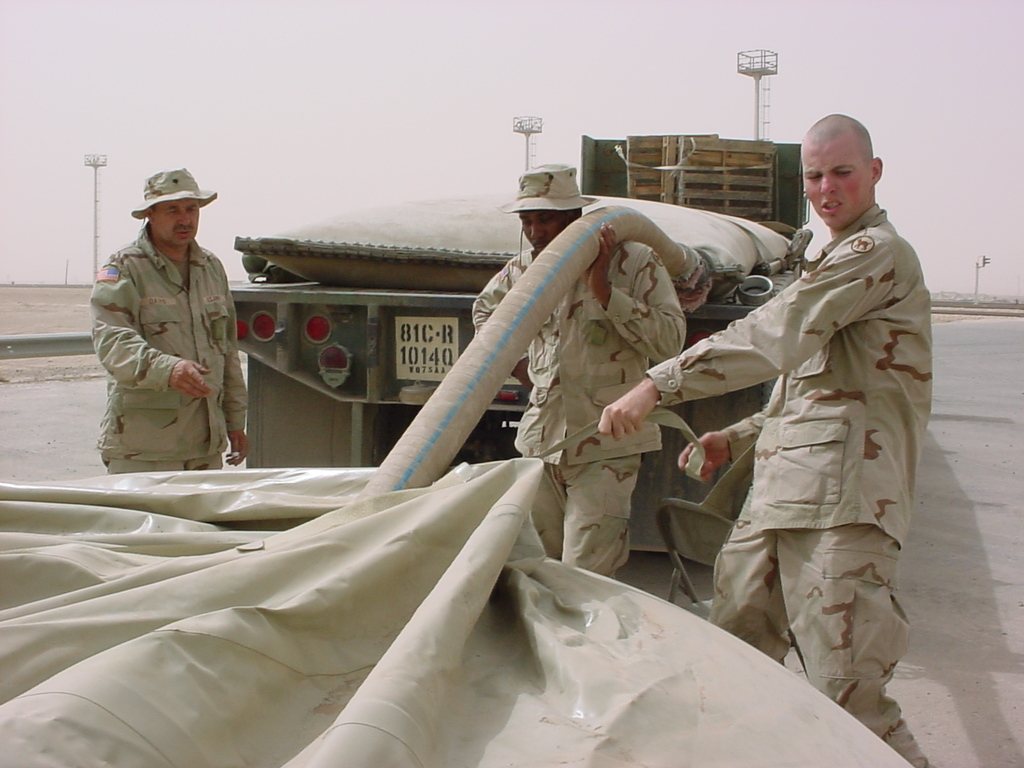
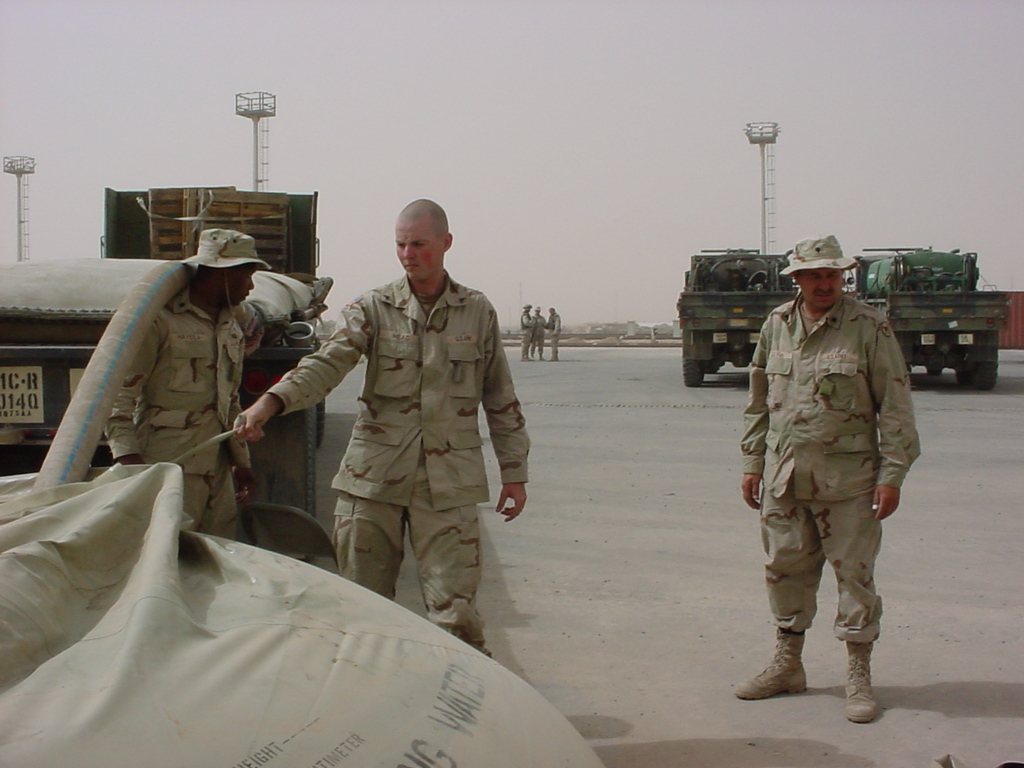
| III | Petroleum, oils and lubricants | Fuel. Every vehicle in greater Baghdad that needed fuel, military or coalition contractor, came to Seitz. The battalion issued about 19 million gallons in five months. The company's own photographs show its soldiers working the hoses and collapsible fuel bladders in May 2003. |
| IV | Construction and barrier materials | Lumber, sandbags, concrete barriers and wire: the materials that turned a burned-out compound into a defended base, and that units across Baghdad needed to harden their own positions. |
| VII | Major end items | Complete systems such as vehicles and generators, issued as whole items to units in the field. |
An Army field article from the 43rd Area Support Group, published in November 2003, showed the Sand Cats at work at Seitz. One photograph caught them at the ration point, where they issued “food, water, fresh fruits and vegetables to soldiers stationed around Baghdad.” Another showed the company running “a large warehouse containing thousands of cases of Meals, Ready to Eat (MREs) and Unitized Group Rations (UGRs).” The same article showed the neighbors the company worked beside every day: the 53rd Quartermaster Company’s fuel point, the 79th Quartermaster Company’s fuel bags, the 1555th’s water tanks, the 542nd’s maintenance bays and the 16th Quartermaster Company’s showers and laundry.
Battalion figures from Stars and Stripes, October 2003, covering the 541st Corps Support Battalion's first five months at Seitz. The 1014th's role in Class I, III, IV and VII operations is from a veteran of the base.
Building the base
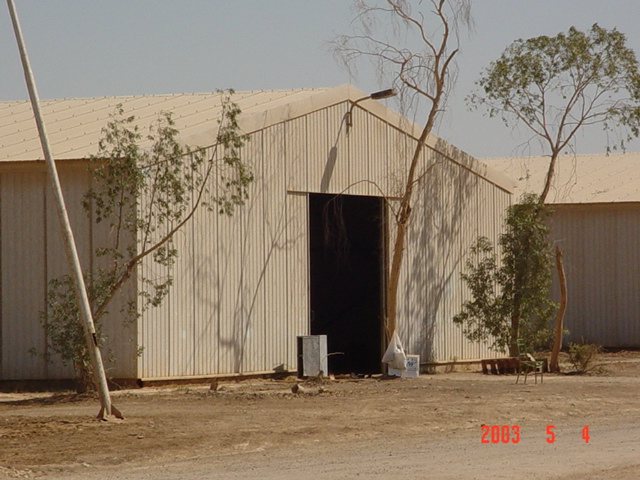
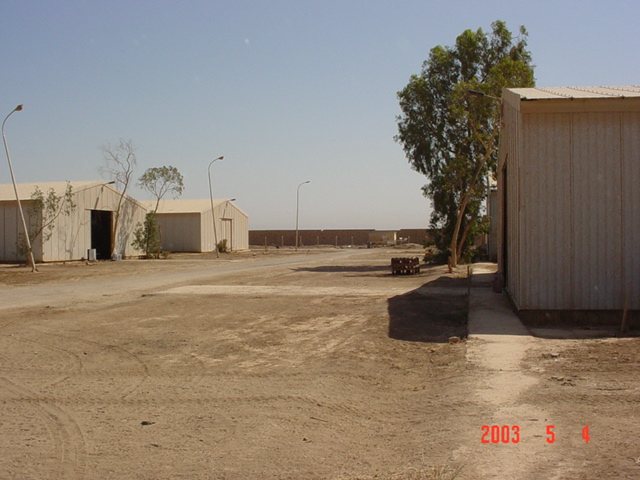
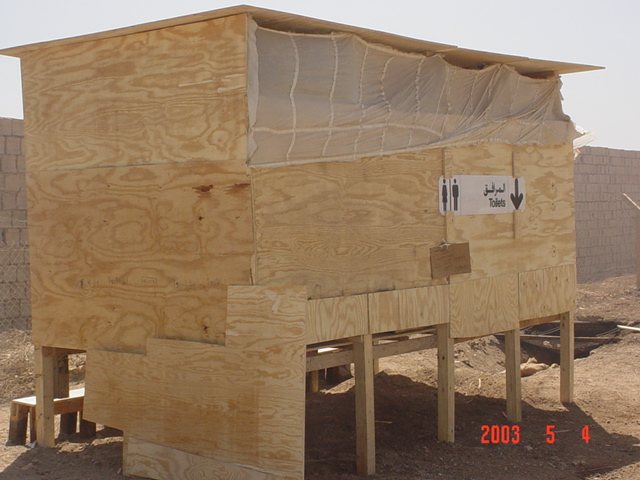
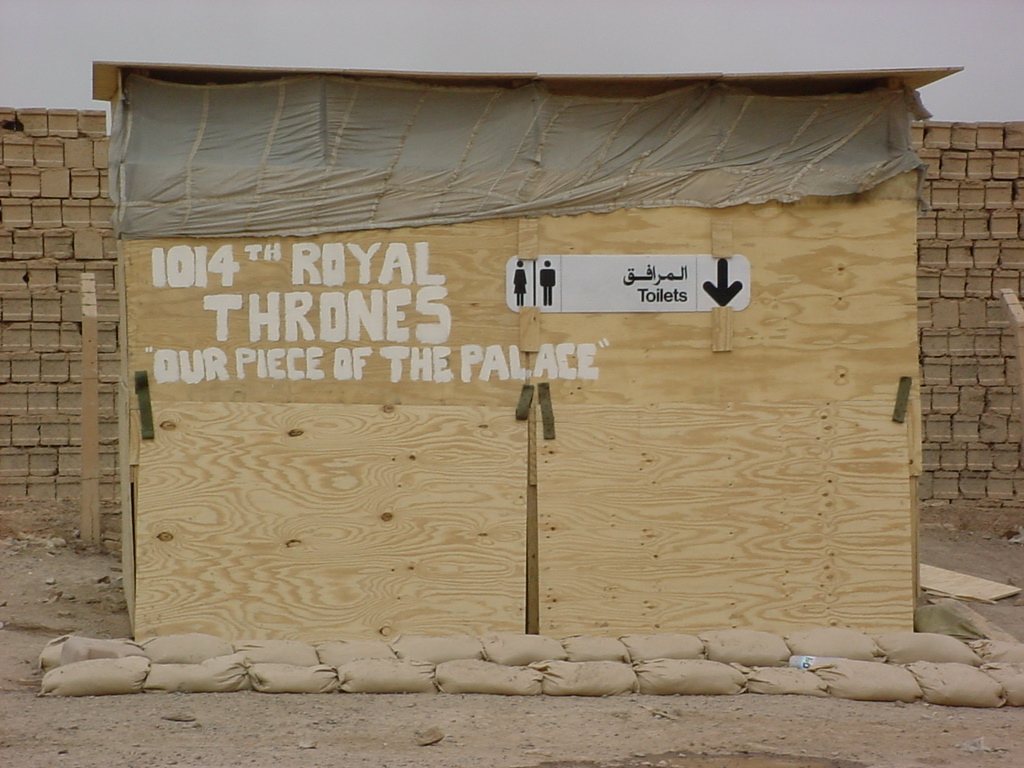
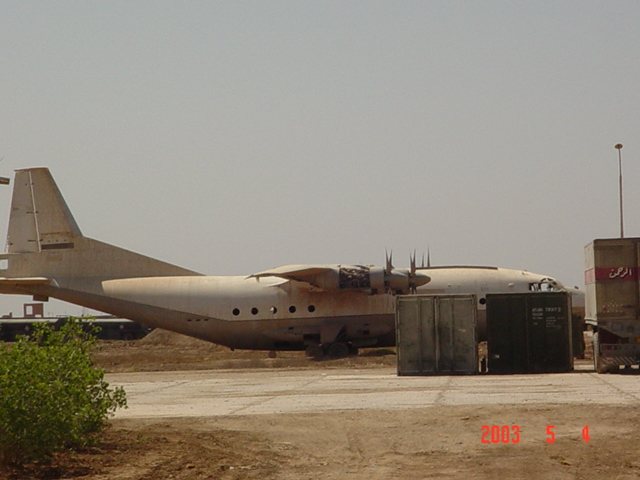
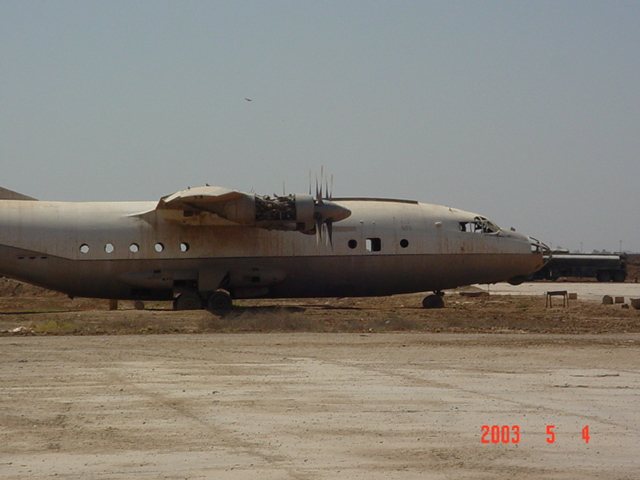
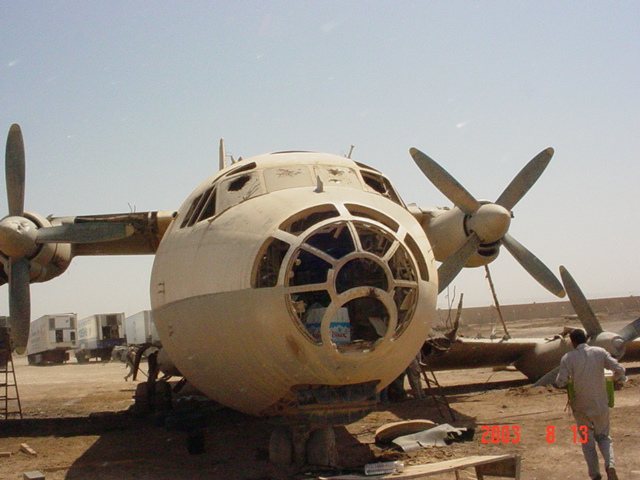
When the battalion arrived, its executive officer told Stars and Stripes, the compound was “full of crap, on fire and full of dead things.” Everything the soldiers used, they built. The 1014th's photographs from the first weeks of May 2003 show it: plywood latrines raised on stilts, waste burned in cut-down drums behind sandbags, smoke rising over the compound wall, and long rows of metal warehouses where soldiers lived and worked. One of the company's latrines carried a hand-painted sign, “1014th Royal Thrones: Our Piece of the Palace.” Nearby, the company photographed the hulks of abandoned Iraqi four-engine transport planes, left where the war had stopped them.
A year under fire
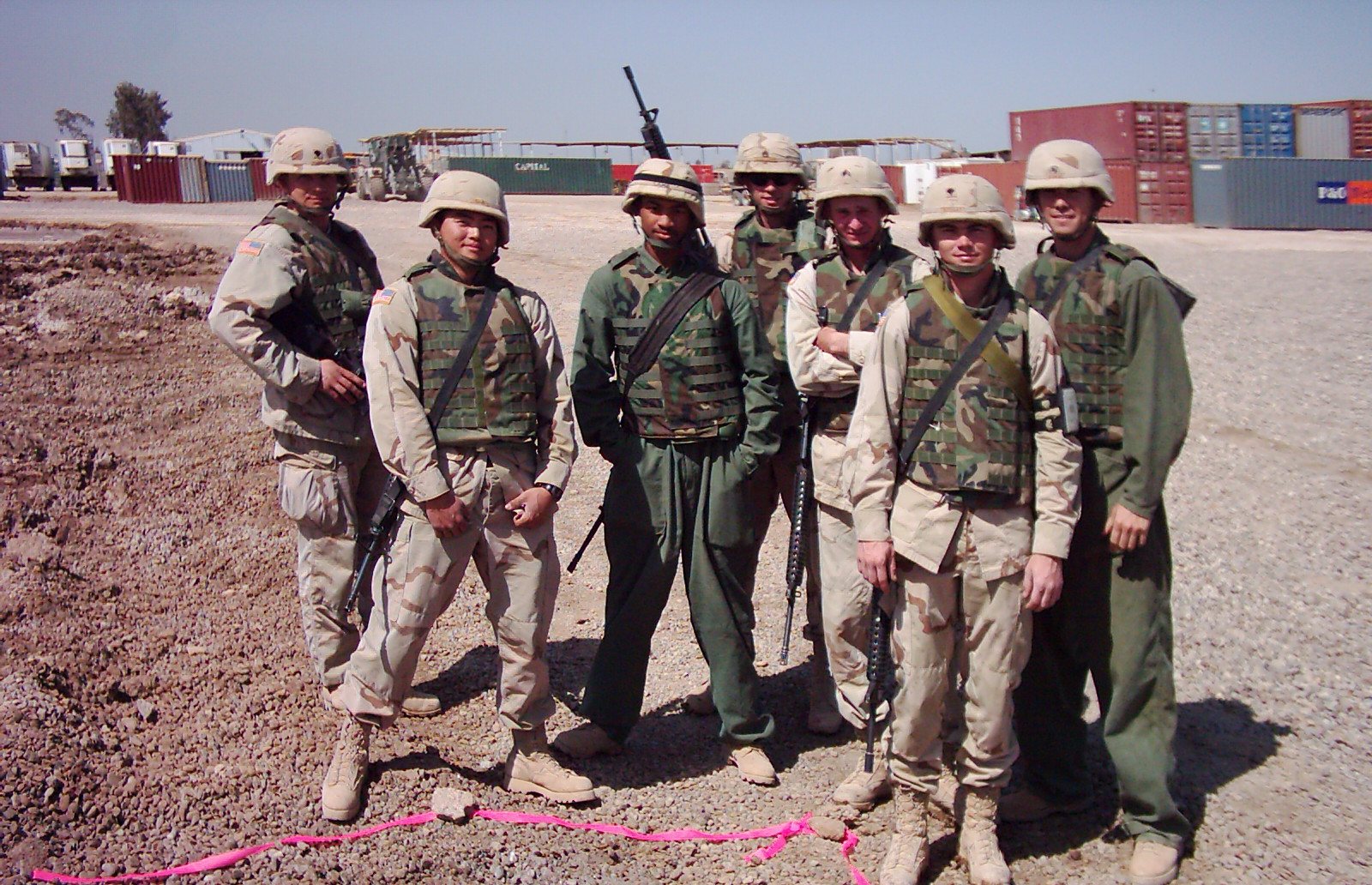
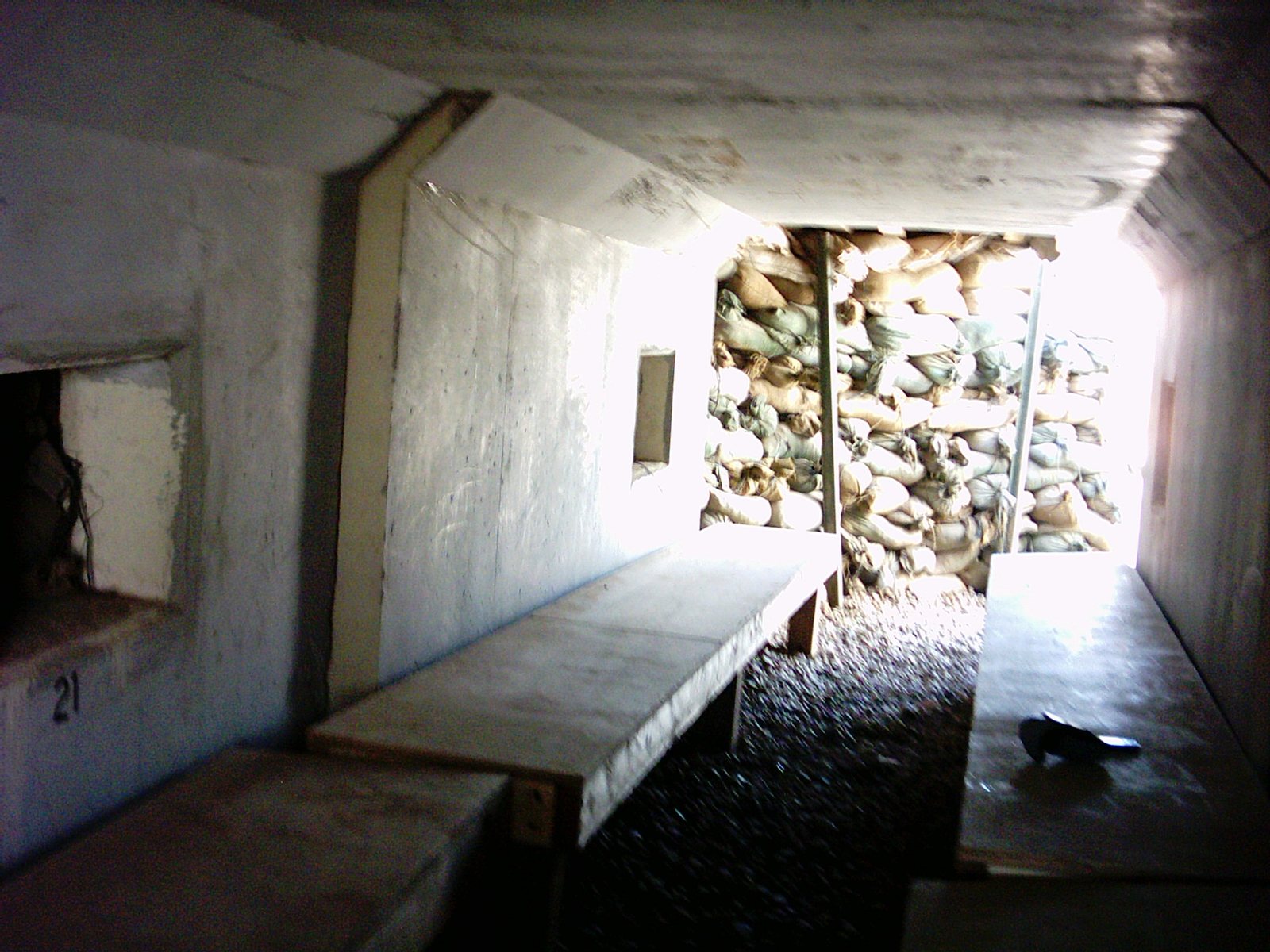
Seitz had no infantry. Its logistics soldiers guarded it themselves, and the 1014th stood its share of guard behind concrete barriers and wire. Mortar and rocket fire came often. By October 2003 the battalion's executive officer, Maj. John Silverstein, counted about 25 attacks and 16 wounded. Veterans of the base remember roughly 330 mortar impacts in 2003, and a 541st soldier who served from April 2003 to April 2004 estimated about 310 confirmed hits in 340 days. In October 2003 the battalion commander, Lt. Col. Curt Higdon, gave the base its nickname, “Mortaritaville.” The worst came on January 7, 2004, when six rounds hit the living area, killing one soldier and wounding about 35. The company's photographs from March 2004 show soldiers in body armor before missions and the inside of a sandbagged bunker. They also show the “Mortaritaville” pavilion, named for the fire everyone on the base lived with.
Life between missions
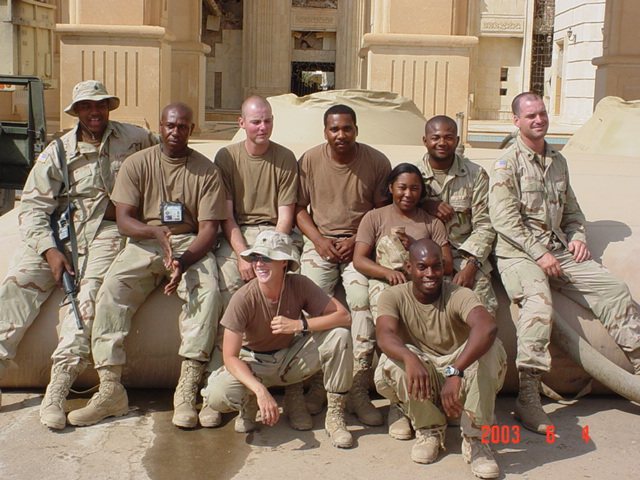
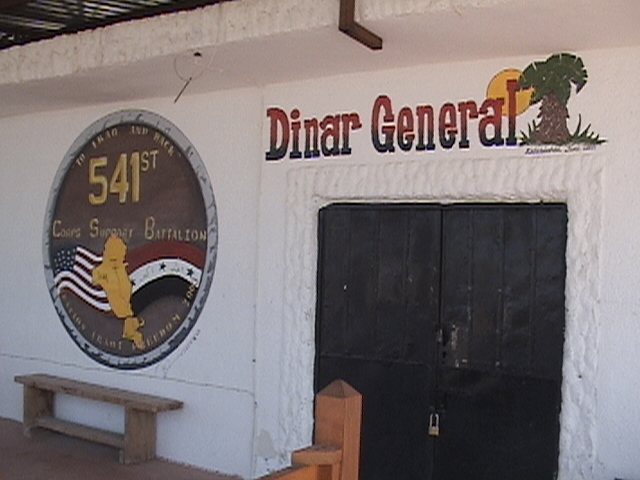
The pictures also show the ordinary days: a wet towel draped over a helmetless head in a truck cab on the Fourth of July, 2003; pickup basketball beside a parked transport plane; a group photo on the steps of a palace in June 2003; the 541st's “Dinar General” store; and sunset behind a mounted machine gun. And in March 2004, a company photographer stood beneath the Crossed Swords in central Baghdad.
Remembered
The company lost a beloved member after the war. Specialist Stephen Matthew Cruz served with the 1014th at Seitz and died in 2015; his memorial is above.
Photographs: the 1014th Quartermaster Company, 2003–2004
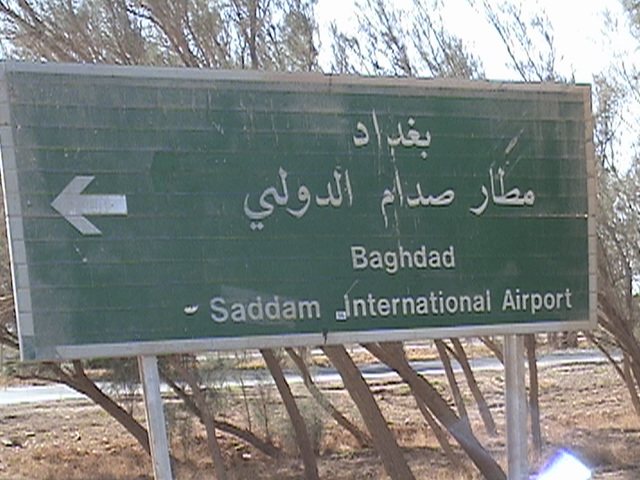
These photographs were taken by soldiers of the 1014th Quartermaster Company, which ran Class I, III, IV and VII logistics operations at the base in 2003 and 2004. If you recognize yourself or a buddy, say so on the message board below.



In print: Surviving Twilight
This memoir is set almost entirely at Log Base Seitz. Sgt. Shane Bernskoetter, an Army Reserve soldier with the 245th Maintenance Company, deployed in late 2003 for Operation Iraqi Freedom II. His journey started at Fort Riley, Kansas, and continued at Seitz, where he spent the next year repairing small arms and, in the publisher's words, “trying to stay alive one day at a time.”
The book grew out of his letters home. Rather than generic e-mails, he sent detailed monthly accounts, PowerPoint presentations with audio and video included, describing daily life under mortar and rocket fire. His unit's training had led them to expect little enemy fire, and the frequency of the attacks surprised them. His mother kept every page in eight three-ring binders. After he came home, he condensed them into daily journal entries, keeping the humor he had always used to defuse hard moments; his wife helped make sure it read as neither offensive nor embarrassing.
“I never intended to write a book; it was a byproduct when I came home,” he told the Associated Press in 2008. He added that compiling it meant reliving the tour, and that going back through the graphic detail in his notes was at times overwhelming. The 245th Maintenance Company also lost one of its own at Seitz: Spc. Melvin Y. Mora was killed in a mortar attack on the base in June 2004.
Sources: Columbia Missourian / Associated Press, July 20, 2008; publisher's description. Copies can be found through booksellers by its ISBN.
Roll call: who served at Logistics Base Seitz
No names have been added yet. This roll call is built from the people who served here, one post at a time.
Message board: Logistics Base Seitz
Served here? Share a memory, name your unit, or send a correction. Posts are reviewed before they appear. The full community board is on the Message Board page.
Sources
- A Way with Words, “Mortarville” (2005), with 61 comments from Log Base Seitz veterans, including Col. (Ret.) Curt Higdon. https://waywordradio.org/mortarville/
- The Sacramento Bee obituary and guest book, Pfc. Jesse D. Mizener (2004), including tributes from Col. (Ret.) Curt Higdon and his company commander. https://www.legacy.com/us/obituaries/sacbee/name/jesse-mizener-obituary?id=27501194
- Stars and Stripes, “'Logistics Warriors' in Iraq not distracted from support mission” (Oct. 6, 2003). https://www.stripes.com/news/2003-10-06/logistics-warriors-in-iraq-not-distracted-from-sup
- The Guardian, “US soldier killed in Iraq mortar attack” (Jan. 8, 2004). https://www.theguardian.com/world/2004/jan/08/iraq.usa1
- Los Angeles Times, “Army Pfc. Jesse D. Mizener, 23; Killed in Mortar Attack” (Jan. 18, 2004). https://www.latimes.com/archives/la-xpm-2004-jan-18-me-mizener18-story.html
- 515th Corps Support Battalion transition of authority (Mar. 22, 2004), reprinted in 517th PRCT Mail Call No. 814. http://517prct.org/mailcall/814.htm
- Waukon Standard, “Sgt. Peter Bieber is Parade Grand Marshal” (1133rd Transportation Company). https://www.waukonstandard.com/content/sgt-peter-bieber-parade-grand-marshal
- Veterans of Log Base Seitz (1544th Transportation Company), “Our Fallen Five”. https://vlbs1544.org/fallen-five/
- Fallen Heroes of Operation Iraqi Freedom, listing for Spc. Melvin Y. Mora. https://www.fallenheroesmemorial.com/oif/?dates=20040106
- CBS News, Iraq photos June 28 – July 4, 2004 (June 30 mortar attack). https://www.cbsnews.com/pictures/iraq-photos-june-28-july-4/
- DVIDS, “Retroactive CABs awarded at Logistical Base Seitz” (Feb. 2, 2006). https://www.dvidshub.net/news/5287/retroactive-cabs-awarded-logistical-base-seitz
- A Way with Words, “Mortarville” (veterans' comments). https://waywordradio.org/mortarville/
- Troy A. Luster, “Freedom is Like a Crown (Part IX) – Homecoming” (about 700 rounds during the 2004 tour). https://www.linkedin.com/pulse/freedom-like-crown-part-ix-homecoming-troy-a-luster-j-d-
- Columbia Missourian (Associated Press), “Soldier's book gives first-hand account of war in Iraq” (July 20, 2008). https://www.columbiamissourian.com/news/local/soldiers-book-gives-first-hand-account-of-wa
- Surviving Twilight: A Soldier's Chronicle of Daily Life in Iraq, A. Shane Bernskoetter (BookSurge, 2005), ISBN 978-1-4196-1917-5. https://www.abebooks.com/9781419619175/Surviving-Twilight-Soldiers-Chronicle-Daily-1419619
- Stars and Stripes, “Mural paints history of logistics base's beginning” (Oct. 6, 2003). https://www.stripes.com/news/2003-10-06/mural-paints-history-of-logistics-bases-beginning-
- GlobalSecurity.org, 541st Combat Sustainment Support Battalion (OIF company list). https://www.globalsecurity.org/military/agency/army/541maint.htm
- On Point: The United States Army in Operation Iraqi Freedom, CFLCC task organization (1014th Quartermaster Co under the 541st Maintenance Battalion, 43rd Area Support Group). https://www.globalsecurity.org/military/library/report/2004/onpoint/cflcc.htm
- The Prairie Press, “Shawna Morrison: Remembering a legacy 20 years later” (2024). https://prairiepress.net/stories/shawna-morrison-remembering-a-legacy-20-years-later,79059
- 81st Regional Readiness Command Regulation 10-6 (April 2004), listing “1014th Quartermaster Company (Supply) (Mobilized) WQ7SAA, Athens, GA”. https://www.scribd.com/document/440878757/81st-REG-10-6-APR-04
- Department of Defense, National Guard and Reserve units called to active duty (lists the 1014th Quartermaster Company, Athens, GA, Army Reserve). https://www.yumpu.com/en/document/view/33949050/national-guard-and-reserve-units-called-to
- CNN, “Mortar attacks kill 2 U.S. soldiers” (March 18, 2004). http://www.cnn.com/2004/WORLD/meast/03/18/soldiers.killed/index.html
- The New York Times, “35 U.S. Soldiers Wounded in Mortar Attack in Iraq” (January 7, 2004). https://www.nytimes.com/2004/01/07/international/middleeast/35-us-soldiers-wounded-in-mort
- HAS HEART, “Ca-Deuces” veteran profile (combat medic at Seitz, 2004–2005). https://hasheart.us/cadeuces/
- GlobalSecurity.org, “Articles from the Field,” 43rd Area Support Group (November 2003). https://www.globalsecurity.org/military/library/report/2003/031104-articles.htm